FIFA World Cup 2026 Final Draw: Everything About Pots, Rules and What’s at Stake
Football fans worldwide are counting down to one of the most anticipated events in the sport’s calendar. The FIFA World Cup 2026 Final Draw on December 5, 2025, will determine the fate of 48 nations competing across the United States, Canada, and Mexico. This isn’t just another draw ceremony—it’s where dreams are made, rivalries are born, and underdogs get their moment. With the tournament’s match schedule set to kick off on June 11, 2026, understanding how the draw works has never been more critical for fans eager to see their nation’s path to glory. The expanded 48-team format introduces complexities that even seasoned football followers might find confusing. From pot allocations to confederation constraints, this guide cuts through the noise and delivers exactly what you need to know before the balls start rolling in Washington DC.
When Does the 2026 World Cup Draw Happen?
Mark your calendars for Friday, December 5, 2025, at 12:00 PM ET (9:00 AM PT, 5:00 PM GMT). The John F. Kennedy Center for the Performing Arts in Washington DC will host this historic event, with U.S. President Donald Trump expected to attend alongside football legends and officials from competing nations.
Where to Watch Live
Multiple broadcasting options ensure fans worldwide won’t miss a moment:
- Global Stream: FIFA.com and FIFA’s official YouTube channel
- UK Viewers: BBC and BBC iPlayer
- US Audiences: Fox and Fubo streaming services
- International: Local broadcasters in over 200 countries
The complete match schedule with specific venues and kick-off times drops the next day, Saturday, December 6, giving teams and fans immediate clarity on their tournament journey.

Breaking Down the 48-Team Revolution
The 2026 edition marks football’s biggest structural change in decades. Here’s what makes this format different:
| Component | Details | Impact |
| Total Teams | 48 (up from 32) | More nations, more matches, more drama |
| Group Configuration | 12 groups of 4 teams | Balanced competition across groups |
| Automatic Qualifiers | Top 2 from each group (24 teams) | Traditional advancement path |
| Third-Place Qualifiers | Best 8 third-place teams | New lifeline for competitive teams |
| Total Knockout Teams | 32 teams in Round of 32 | Expanded knockout stage opportunities |
This structure fundamentally changes tournament strategy. Nations that historically struggle in group play now have realistic paths forward—a single victory combined with favorable results elsewhere could secure knockout stage qualification.
The Four Pots: Who’s Where and Why It Matters
Team placement into pots follows the FIFA Men’s World Ranking from November 2025, with host nations receiving automatic Pot 1 placement regardless of ranking.
Pot 1: The Elite Dozen
| Team | FIFA Rank | Key Strength |
| Spain | 1 | European champions, Lamine Yamal factor |
| Argentina | 2 | Defending champions, seeking back-to-back titles |
| France | 3 | 2022 finalists, unbeaten in qualifying |
| England | 4 | Perfect qualifying record, zero goals conceded |
| Brazil | 5 | Five-time champions, CONMEBOL pedigree |
| Portugal | 6 | Experienced squad with emerging talent |
| Netherlands | 7 | Consistent tournament performers |
| Belgium | 8 | Golden generation’s last chance |
| Germany | 9 | Rebounding after consecutive group stage exits |
| USA | 27 (Host) | Home advantage, Pochettino’s tactics |
| Mexico | 15 (Host) | Opening match at Estadio Azteca |
| Canada | 27 (Host) | Lowest-ranked Pot 1 team, favorable draw option |
Reality Check: Canada’s 27th global ranking makes them the “weak link” in Pot 1—every competing nation secretly hopes to draw them rather than facing Spain, Argentina, or France.
Pot 2: The Proven Challengers
Complete Lineup: Croatia, Morocco, Colombia, Uruguay, Switzerland, Japan, Senegal, IR Iran, Korea Republic, Ecuador, Austria, Australia
Croatia reached back-to-back World Cup finals (2018, 2022), while Morocco’s 2022 semi-final run shocked the football world. Uruguay topped South American qualifying behind Argentina, and Japan continues their consistent World Cup presence. Any Pot 1 team drawing Croatia, Morocco, or Uruguay faces immediate pressure.
Pot 3: The Upset Specialists
Complete Lineup: Norway, Panama, Egypt, Algeria, Scotland, Paraguay, Tunisia, Côte d’Ivoire, Uzbekistan, Qatar, Saudi Arabia, South Africa
Norway’s perfect qualifying record behind Erling Haaland’s goals makes them Pot 3’s most dangerous squad. Egypt brings Mohamed Salah’s attacking brilliance, while Scotland returns to the World Cup stage with renewed confidence. Uzbekistan makes history as one of four tournament debutants.
Pot 4: Debutants and Playoff Hopefuls
Confirmed Teams: Jordan, Cabo Verde, Ghana, Curaçao, Haiti, New Zealand
Playoff Placeholders: European Play-Off A, B, C, D + FIFA Play-Off Tournament 1, 2
Curaçao’s qualification with just 185,000 residents represents the tournament’s feel-good story. However, the six playoff spots create intrigue—four-time champions Italy could land here, instantly transforming any group into a nightmare scenario.
How the Draw Actually Works: Step-by-Step
The draw ceremony follows precise procedures designed to balance competitive fairness with geographical distribution requirements.
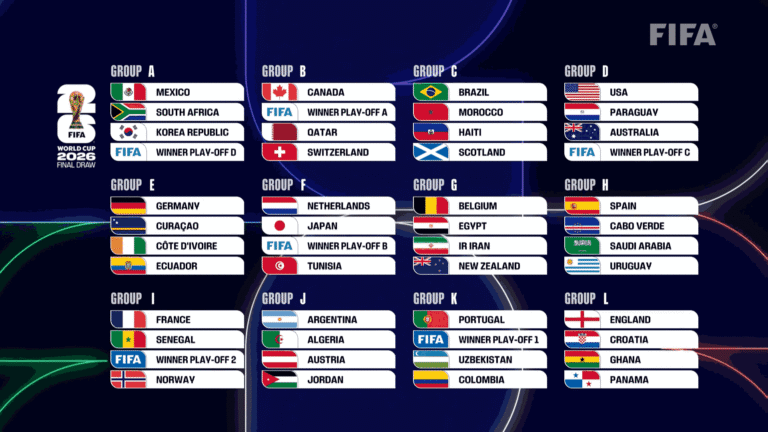
Host Nation Pre-Assignments
Before any balls are drawn, three hosts already know their groups:
- Mexico → Group A: Opens the tournament at Estadio Azteca on June 11
- Canada → Group B: Second match in Toronto on June 12
- USA → Group D: Third match in Los Angeles on June 12

The Drawing Sequence
- Pot 1 Distribution: Nine remaining teams drawn into Groups C, E, F, G, H, I, J, K, L
- Pot 2 Allocation: All 12 teams distributed across groups
- Pot 3 Assignment: Teams fill remaining group positions
- Pot 4 Completion: Final spots filled, including six playoff placeholders
Critical Confederation Rules
Understanding these constraints explains why certain teams can’t meet:
General Principle: No two teams from the same confederation in one group
UEFA Exception: With 16 European teams across 12 groups, each group must contain either 1 or 2 UEFA nations
Playoff Constraint: Placeholder teams carry confederation restrictions based on potential qualifying nations
Example: If Group A already contains Brazil (CONMEBOL), no other South American team can join that group during subsequent draws.
The Pathway System: Protecting Top Seeds
FIFA implemented a bracket pathway system ensuring competitive balance:
| Ranking | Team | Pathway Placement |
| 1 | Spain | Pathway 1 |
| 2 | Argentina | Pathway 2 (opposite Spain) |
| 3 | France | Pathway 3 |
| 4 | England | Pathway 4 (opposite France) |
What This Means: Spain and Argentina can only meet in the final (if both win their groups). They could face France or England in semi-finals, but the top two seeds are kept apart until the ultimate match.
Nightmare Draws: Potential Groups of Death
Every tournament produces brutally difficult groups. Here are 2026’s worst-case scenarios:
Scenario 1: The European Gauntlet
- Pot 1: Germany (desperate for redemption after consecutive group exits)
- Pot 2: Croatia (2022 semi-finalists)
- Pot 3: Norway (Haaland’s perfect qualifying record)
- Pot 4: Italy (if qualified via playoffs)
Four nations with realistic title aspirations, one group. Someone goes home early.
Scenario 2: South American Warfare
- Pot 1: Brazil
- Pot 2: Uruguay (fierce regional rivalry)
- Pot 3: Egypt (Salah’s attacking threat)
- Pot 4: Ghana (experienced World Cup performers)
Physical football, intense rivalries, and no easy matches for anyone.
Scenario 3: Host Nation Pressure Cooker
- Pot 1: USA (home crowd expectations)
- Pot 2: Morocco (2022’s surprise package)
- Pot 3: Algeria (African champions pedigree)
- Pot 4: Any playoff qualifier
The Americans face massive pressure with no guaranteed easy opponents.
Who’s Still Fighting for Their Spot?
Six qualification spots remain undecided until March 2026 playoffs, adding uncertainty to the draw.
European Playoff Battles (4 Spots Available)
16 Nations Competing: Albania, Bosnia and Herzegovina, Czechia, Denmark, Italy, Kosovo, Northern Ireland, North Macedonia, Poland, Republic of Ireland, Romania, Slovakia, Sweden, Turkey, Ukraine, Wales
Italy’s playoff path represents one of football’s biggest storylines. The four-time champions must navigate Northern Ireland before facing Wales or Bosnia and Herzegovina. Failure would mark an unprecedented disaster for the Azzurri.
Intercontinental Playoffs (2 Spots Available)
Semi-Final Matchups:
- Jamaica vs. New Caledonia → Winner faces Congo DR
- Bolivia vs. Suriname → Winner faces Iraq
These nations discover their group assignments on December 5 despite not knowing if they’ll actually qualify—unusual but necessary given the tournament timeline.
Tournament Debutants Making History
Four nations will experience World Cup football for the first time:
- Uzbekistan (Pot 3): Central Asia’s breakthrough moment represents decades of football development paying off
- Jordan (Pot 4): Middle Eastern representation expands with their historic qualification
- Cape Verde (Pot 4): The island nation’s 560,000 population celebrates their biggest sporting achievement
- Curaçao (Pot 4): At just 185,000 residents, they’re the smallest nation to ever reach a World Cup
New Zealand, despite previous appearances, ranks lowest at 86th in FIFA rankings—four spots below Curaçao at 82nd.
Teams and Players Commanding Attention
Spain: European Champions with Teenage Sensation
World No. 1 Spain enters as tournament favorites behind Barcelona prodigy Lamine Yamal, who’ll make his World Cup debut at just 18. Their possession-based philosophy and Euro 2024 triumph create massive expectations.
Argentina: Chasing Consecutive Glory
Defending champions Argentina topped CONMEBOL qualifying and seek to become the first nation since Brazil (1958, 1962) to win back-to-back World Cups. Their squad depth and tournament experience make them perennial threats.
England: Perfect Record, Persistent Doubts
Eight consecutive qualifying victories without conceding a single goal demonstrate England’s defensive solidity. Yet their knockout stage history raises questions about their ability to deliver when pressure intensifies.
Norway: The Haaland Factor
Erling Haaland’s goal-scoring prowess gives Norway a legitimate threat against any opponent. His Manchester City form translated perfectly to international qualifying, where Norway posted a perfect record.
What Happens After December 5?
The draw ceremony triggers immediate developments across the football world:
December 6: FIFA releases the complete match schedule with all venue assignments and kick-off times
December-March: Qualified nations analyze opponents, schedule friendly matches, and develop tactical approaches
March 2026: Playoff tournaments determine the final six participants, who immediately join their pre-assigned groups
June 11, 2026: Tournament kicks off at Estadio Azteca with Mexico’s opening match
The 188-day countdown from draw to opening match begins the moment the final group is confirmed. Check the complete qualified teams list to see which nations have already secured their spots.
Expert Analysis: How the Format Changes Strategy
Football analysts predict significant tactical shifts with the expanded format:
Aggressive Early Approaches: Knowing eight third-place teams advance, coaches may take more risks in opening matches rather than playing cautiously for draws.
Squad Depth Becomes Critical: Teams potentially playing seven matches (three group games plus four knockout rounds) need rotation options.
Home Field Advantage: The USA, Mexico, and Canada historically benefit from home support, with host nations often exceeding pre-tournament expectations.
Third-Place Calculations: Final group stage matches could see teams strategically managing goal difference and disciplinary records to secure third-place qualification.
Historical Context and Entertainment
The 1994 World Cup in the United States featured a Las Vegas draw ceremony with performances by Rod Stewart, Stevie Wonder, and James Brown. While FIFA hasn’t confirmed 2025’s entertainment lineup, Colombian artist J Balvin performed at the recent FIFA Club World Cup final in New Jersey, suggesting potential involvement.
FIFA President Gianni Infantino will also present the inaugural FIFA Peace Prize during the ceremony, recognizing individuals working to end conflicts and unite communities. The recipient remains unannounced, though speculation connects it to President Trump’s attendance and his self-described “President of Peace” identity.
Why This Draw Matters More Than Ever
The December 5 draw transcends mere group assignments. It creates narratives that will dominate sports coverage for months. It determines whether Messi’s Argentina can defend their crown. It reveals if England finally converts potential into silverware. It shows whether Haaland can carry Norway beyond their historical limitations.
For the 42 nations already qualified, the draw provides clarity and direction. For playoff hopefuls, it offers motivation and stakes. For fans who purchased early lottery tickets without knowing matchups, it transforms abstract possibilities into concrete reality.
Stay updated with all latest FIFA World Cup 2026 developments as the tournament approaches and storylines develop.
Frequently Asked Questions
When is the FIFA World Cup 2026 Final Draw taking place?
The draw happens Friday, December 5, 2025, at 12:00 PM ET from Washington DC’s Kennedy Center. Watch live on FIFA.com, FIFA’s YouTube channel, BBC (UK), or Fox Sports (US).
How are teams distributed across the four pots?
Pots are determined by FIFA Men’s World Rankings from November 2025. Pot 1 includes the three hosts plus the nine highest-ranked teams. Remaining teams fill Pots 2-4 by ranking, with six playoff placeholders in Pot 4.
Can teams from the same region be drawn together?
No, except for UEFA. Each group can contain maximum one team per confederation, but since 16 European teams exist across 12 groups, each group must have 1-2 UEFA nations.
What is the pathway system for top-ranked teams?
The top four ranked teams (Spain, Argentina, France, England) are placed in separate pathways ensuring Spain and Argentina can’t meet before the final, same for France and England. They could meet in semi-finals.
How many teams advance from the group stage?
32 teams advance: the top two from each of the 12 groups (24 teams) plus the eight best third-place finishers based on points, goal difference, and goals scored.
Which teams are making their World Cup debut in 2026?
Four debutants: Uzbekistan (Pot 3), Jordan (Pot 4), Cape Verde (Pot 4), and Curaçao (Pot 4). Curaçao becomes the smallest nation ever to qualify with just 185,000 residents.
The December 5 draw doesn’t just determine matchups—it ignites dreams, creates heroes, and sets the stage for football’s grandest spectacle. With 48 nations competing across North America, the expanded format guarantees surprises, upsets, and moments that will define careers. Whether you’re following traditional powerhouses or cheering for tournament debutants, this draw matters. It’s where the journey to July 19’s final in New York/New Jersey truly begins.